English
Views: 600 Author: Charlotte Hill Publish Time: 2026-09-18 Origin: WellPromotion Custom Custom Makeup Case
Across beauty brands, gift programs and professional makeup services, the custom makeup case is one of the most common packaging and carrying formats. When launching a custom makeup case project, buyers usually need to address structural design, logo presentation, and production scheduling at the same time. As a professional bag manufacturer, WellPromotion provides global buyers with support across requirement alignment, solution refinement, sampling confirmation, and mass production delivery.
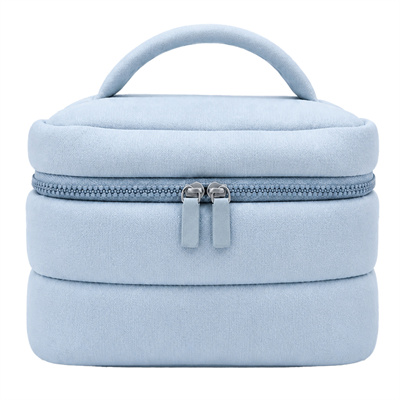
How to Design a Custom Makeup Case: Size, Shell and Interior
1.1 Size and Internal Layout
Case size starts with what goes inside it. Powder compacts, lipsticks, brushes and mirrors each claim space differently, so buyers should list every item with its dimensions and quantity first. That list sets the outer shape, capacity and contour — and gives the factory something concrete to quote against.
1.2 Shell Materials
Material selection needs to take weight, durability, appearance, and target price point into account at the same time. Shell options include PU synthetic leather, canvas, nylon, polyester, clear PVC and recycled polyester fibre, among others. Among them, fabric shells feel softer and work well for retail and gift promotions; RPET suits brands with published sustainability targets.
1.3 Internal Structure Configuration
Once the outer dimensions are set, the interior is planned around the contents. Compartment count and how each item is held in place depend on item shape: fragile items get foam cushioning, liquids get a leak-proof lining, and brushes or tools get dedicated slots.
Beyond that, the layout can add removable dividers, foam trays, brush slots, mesh pockets, zipper pockets, mirrors, LED lighting and trolley wheel assemblies — specify only what the end user will actually use.
1.4 Hardware and Edge Finishing
The hardware of a custom makeup case includes zippers, pullers, locks, hinges and handles. Zipper tape and pullers matter most: they set how smoothly the case opens and how long it lasts. Specifying branded tape (YKK, SBS) or a custom puller is one of the cheapest ways to signal quality. Edge finishing deserves the same attention — binding, edge painting and heat-sealed edges largely decide how clean the case looks.
1.5 Compliance and Safety Requirements
With the structure and materials settled, the case still has to clear the rules of the destination market. Skin-contact materials must comply with EU REACH, US CPSIA and California Prop 65 where applicable.
If the programme needs social compliance or factory audit documentation (BSCI, SEDEX), request it at the quoting stage — test reports and audit support can be arranged, but lead time goes up.
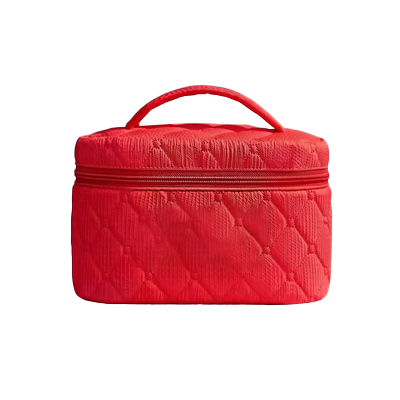
Custom Makeup Case Logo Options and Brand Consistency Control
2.1 Surface Logo Techniques
Common options include screen printing, heat transfer, embossing, digital printing, embroidery, metal nameplates and woven labels. Each technique pairs with specific materials: fabric takes embroidery and heat transfer, PU leather takes embossing and hot stamping, and rigid panels or metal take screen printing and nameplates.
A single case can also combine methods — an embossed main logo on the shell, for example, paired with a printed care label — to separate primary branding from secondary information.
2.2 Branding at the Structural Level
Brand identity does not have to stop at the surface. Custom zipper pulls, printed lining, custom-color fabrics, bespoke molded parts and coordinated shell-and-trim colorways all carry the brand structurally — an approach that outlasts surface printing because it is built into how the case works. WellPromotion matches Pantone or buyer-supplied color codes during sampling, so shell, lining and hardware land on-brand before bulk cutting.
2.3 Packaging and Unboxing
Beyond the case itself, packaging needs the same level of planning: hang tags, belly bands, gift boxes, barcode labels and tissue paper. Packaging materials can be recyclable paper and eco-friendly materials to support the brand's sustainability claims.
2.4 Brand Consistency Control
Color and logo drift between the approved sample and bulk production is where most disputes start. Four controls keep it in check: matching against standard color swatches, supplying vector artwork, defining minimum line width and logo position, and keeping the signed sample as the acceptance reference. Buyers should lock these four points in writing at sign-off — it is the cheapest way to avoid disputes once production starts.
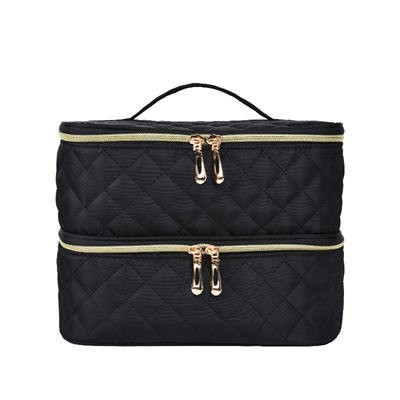
Custom Makeup Case Production Process: From Brief to Shipment
3.1 Requirement Alignment and Quotation
A custom makeup case project starts with a clear brief. Buyers send style references, target dimensions, material direction, logo artwork, order quantity, packaging requirements and delivery destination; the supplier then assesses feasibility and quotes. Quantity, material and logo technique drive most of the cost difference. Once the quote is approved, development begins.
3.2 Drawing and Material Confirmation
Development starts with drawings or 3D renderings that fix dimensions, structure and materials. Both parties sign off on the outer fabric, lining and trim — specification, color and finish — plus the hardware model and surface treatment. With the spec sheet locked, the pre-production sample is built.
3.3 Sampling and Sample Sign-off
The pre-production sample is where structure, dimensions, materials and logo application are verified before bulk cutting. Buyers review it and return revision comments; the supplier adjusts and re-samples. Once approved, this unit becomes the signed golden sample — the reference standard for both mass production and final inspection.
3.4 Mass Production and In-Process Inspection
Production starts against the signed sample. Inspectors check each stage — cutting, stitching, hardware assembly, logo placement and lining installation — so batch deviations are caught on the line rather than at the finished-goods stage.
3.5 Final Inspection and Shipment
Finished cases undergo a final AQL inspection covering appearance, dimensions, zipper function, color deviation, logo placement and packing. On approval, the supplier arranges packing, labeling and dispatch by sea, air or international express, depending on the buyer's lead time and freight budget.
3.6 Lead Time and Common Risks
Total lead time covers three blocks: sampling, mass production and transit. Style complexity, material availability and order quantity are the main variables. Delays most often come from tooling or mold making, long procurement cycles for specialty materials, and peak-season capacity constraints, among others. Flagging these at the quoting stage is the cheapest way to protect the delivery date.
WellPromotion Custom Makeup Case From YouTube
Conclusion
Procurement outcomes come down to three decisions — structure, logo and production — and these three affect one another. Buyers who pin down contents, end use, quantity and lead time at the brief stage cut both sampling rounds and delivery risk.
WellPromotion supports requirement alignment, sampling, production follow-up, inspection and shipment. To start a custom makeup case project, send style references, target quantity and required delivery date for a quote and sampling.